 Translated by Margarita Ponomariova and Kim Green
As a source of stories and ideas, is there anything that can compare to World War II? Its scale and impact was so monumental, it seems every type of conflict affecting people from all walks of life and all corners of the world, every moral dimension and literary archetype can be drawn from the real life experiences of the war. For a time period that has been covered as extensively as it has been by our popular culture over the past six decades, there still seem to be limitless supplies of new and compelling stories to be mined from its depths.
The most recent example I've encountered is also one of the best military memoirs I can recall reading.
Red Sky, Black Death is the story of Anna Yegorova, a ground attack pilot who fought for the Soviet Union during World War II. The book traces her youth, from her time as a proud communist worker building the Moscow underground, to becoming one of the world's only female attack plane pilots, finally ending with her struggle against the shameful stigma placed on her by Stalin's policies as a former prisoner of war. The Soviet Union was the only country to officially recruit women for combat duty during the war. Even having read numerous first hand accounts and non-fiction books on the subject of Soviet women combat pilots, Yegorova's story still surprised and enthralled me in equal parts.
First and foremost, what stands out is the quality of writing and translating. Yegorova's experiences are interesting enough on their own, however, given the length of time that has passed, it could easily devolve into either unlinked snippets of memories or a grocery list of events. It is neither of these things. The book is a story and it holds together a clear sense of events as they happened, sometimes sprinkling with intimations of the future and how the recollections linger in the present. The narrative momentum never falters. Further making her telling stand out is her unusual openness about the contradictions in Soviet life at the time. Many similar memoirs suffer from excessive influence from Soviet era propaganda that the authors' experienced, or simply gloss over the political realities. But having bitterly confronted her own brother's persecution during one of Stalin's purges as well as her own after the war, Yegorova gives us a fully formed notion of the cruel ironies of risking and sacrificing so much country she loves that is ruled by such a repressive system.
What would have served to improve the book would have been an appendix, which could clarify the progression of time and place during the narrative (a bare bones timeline is offered as a preface.)
Still, this is a personal record, and it stands with the best military memoirs from the war. I am very happy that this book has found an English translation, as it sheds light on several little known (in the Western world at least) corners of the World War II canon. It is such a rarity not only as a memoir of the Soviet experience, but also of a woman in combat.

(out of 5)

 Courtenay Place. A warm autumn evening. I was having MSG-soaked noodle soup as drunken and well up for it boys and girls were filtering into the bar district. My main preoccupation was going home, battling a cold and tired from being out the night before. Sleep, precious sleep. Then I got a text from Joel, urging me to come out for drinks. I hadn’t shaved, wasn’t dressed for it and definitely wasn’t in the mood. But with job prospects slim, my Belgian pal might be leaving for home soon, so this could be the last week I would have with the best friend I had made since arriving in the country. We like to think our lives are storybooks and the most important decisions in our lives are foreshadowed as momentous.
 I recently enjoyed watching the Dutch movie Admiral on Netflix. In its home country, it was originally titled Michiel de Ruyter, a name likely unknown outside of the Netherlands and military history circles. Given my interest in the subject, I had some familiarity with de Ruyter's story, so I was excited that a dramatization was so readily accessible to me. Being able to watch it was the result of an intersection between two technologically driven trends.
 Lee uses her background as a scholar of Victorian literature to good effect in telling the story of Mary Quinn, a street urchin who is saved from hanging by a reform school. After progressing through the school to become a teacher, she gains the knowledge that the school is actually a front for a secret agency. Lee knows the particular expectations that Victorian society places on women. So the agency carries out work that women have the distinct opportunity to do: to blend in, be unnoticed and unheard.
 Fusion had a piece today about Stan Lee promoting a new lapel pin designed to encourage "cross-cultural respect." Its design is a simple image of two hands shaking, one black, one white, with the word "Respect" emblazoned across the top.
 Translated by Margarita Ponomariova and Kim Green
 Once of the byproducts of actually hitting a wave of creativity and writing feverishly all day is the fact that you end up too wired to sleep properly. While I'm too wired many night, unfortunately this is usually due to eight hours of marathon gaming and forgetting to eat or drink. Thankfully, for both situations, I have found an easy, surefire way to get to sleep quick: a YouTube hit of British history documentaries.
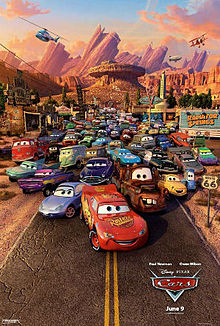 This may put be in the minority of adults, but I like Cars. The movie. Yes that one. I admit I liked the story even when it's world building and internal logic seemed incomprehensible. I only liked it more when I realized it was really about driverless cars who take on human characteristics and adopt human culture as a way to assuage their guilt and emotionally hollow cores for wiping out their creators in an apocalyptic war.
 "You should totally judge a book by its cover." That was the advice
of a friend back in college when recommending fantasy and sci-fi
novels. This was in the days before the ubiquitous blogs, review sites,
Amazon recommendations and tweets helped us to pick out our next read
(I'm severely dating myself, aren't I?)
"You should totally judge a book by its cover." That was the advice
of a friend back in college when recommending fantasy and sci-fi
novels. This was in the days before the ubiquitous blogs, review sites,
Amazon recommendations and tweets helped us to pick out our next read
(I'm severely dating myself, aren't I?)
 In recent news, computers can now beat us at video games they're not even programmed to play. I think we can now officially begin the countdown to the robot takeover.
.jpg) When reading a book on true history, I find that the notes sections are often what makes the overall quality of the work shine through. If I feel compelled to read through the notes, this tells me a few important things. It usually means that the work is well researched, and allows the notes to present a clear basis for the author's statements, as well as alternative interpretations of the evidence. Well written notes give enough context that I don't feel the need to annoyingly flip back and forth between sections. Most importantly, if I'm spending time reading through the notes, it means I didn't want the story to end.
When reading a book on true history, I find that the notes sections are often what makes the overall quality of the work shine through. If I feel compelled to read through the notes, this tells me a few important things. It usually means that the work is well researched, and allows the notes to present a clear basis for the author's statements, as well as alternative interpretations of the evidence. Well written notes give enough context that I don't feel the need to annoyingly flip back and forth between sections. Most importantly, if I'm spending time reading through the notes, it means I didn't want the story to end.
